
The first time someone explained "layering" to me, they used the phrase "adjust your microclimate." I nodded. I had no idea what they meant. Then they started talking about hydrophilic vs. hydrophobic membranes and I mentally checked out and wore a cotton sweatshirt on my next three hikes because at least I understood how a sweatshirt worked.
The outdoor industry has a way of making simple things sound complicated. Layering isn't complicated. It's what you already do when you put on a sweater because you're cold and take it off because you're warm. Hiking layers are just that instinct, applied with fabrics that don't turn into wet garbage when you sweat.
Here's the no-jargon version.
The Only Concept You Actually Need
You've already layered today. You put on a shirt this morning. Maybe a sweater. Maybe a jacket. When you walked outside and felt cold, you zipped up. When you got into a warm car, you unzipped. That's layering. You already know how.
Hiking layers follow the same rule, but instead of cotton and denim, you use fabrics that keep working when you sweat. That's the whole secret. Everything else — the three-layer systems, the breathability ratings, the $600 shells — is optimization for people who want to nerd out. You don't need it to get started.
Here's the rule: wear fabrics that don't hold water, and add or remove pieces as your temperature changes.
That's it. That's the whole thing.
The Three Jobs Your Clothes Need to Do
Every piece of clothing you wear hiking does one or more of three jobs. You don't need a special shirt for each job. You just need to understand the jobs so you know what to reach for.
Job #1: Move sweat away from your skin.
When you hike uphill, you sweat. If your shirt holds that sweat like a sponge, you get cold the moment you stop moving. Cotton is a sponge. Merino wool and polyester are not. They let moisture pass through and evaporate. This is the only job your base layer needs to do.
Job #2: Trap warm air near your body.
When you stop moving, your body heat dissipates fast. A fleece, a puffy jacket, or even a thick wool sweater traps that heat in tiny air pockets. This is insulation. It works whether you're wearing a $300 Patagonia jacket or a $15 Decathlon fleece. The principle is the same.
Job #3: Block wind and rain.
Wind strips heat off your body faster than cold air alone. Rain makes everything wet, and wet things make you cold. A wind shell or rain jacket stops wind and water from reaching your insulating layers. It doesn't need to be breathable. It doesn't need a Gore-Tex membrane. It needs to block wind and water. That was true in 1985 and it's true now.
The Fabrics That Actually Matter
You don't need to memorize a fabric glossary. You need to know three materials. Everything else is someone trying to sell you something.
Merino Wool
What it is: Wool from merino sheep. The fibers are finer than human hair — much finer than the wool in your grandmother's itchy Christmas sweater.
Why it works: It pulls sweat off your skin without feeling wet. It doesn't stink, even after multiple wears. It keeps insulating when damp. It regulates temperature better than any synthetic fabric I've worn.
When to use it: Against your skin — T-shirts, long-sleeve base layers, socks, underwear. This is where merino earns its price.
The catch:The catch: It costs more than synthetic options. A merino T-shirt runs $55–80. A synthetic one runs $20–35. Merino also dries slightly slower than polyester, though it still dries much faster than cotton.
You don't need to know: Micron counts, gsm weights, or whether the sheep were raised at a specific altitude. A 150-200gsm merino shirt from any reputable brand will work.
Polyester Fleece
What it is: Synthetic fabric with a fuzzy, lofted texture that creates air pockets.
Why it works: It traps warm air. It breathes. It keeps insulating when wet. It's cheap, durable, and almost impossible to ruin.
When to use it: As a midlayer over your base layer when you need more warmth. It can also function as a casual outer layer in dry weather.
The catch: It doesn't block wind at all. A breeze goes right through fleece. High winds require a shell over it. It also holds odor more than merino, so wash it occasionally.
You don't need to know: Grid fleece vs. high-loft fleece vs. Polartec variants. A basic 200-weight polyester fleece does the job. The Decathlon MH100 at $15 is functionally identical to a Patagonia Micro D at $59. Patagonia's is softer and better-made. Both keep you warm.
Nylon or Polyester with DWR (Your Shell Layer)
What it is: A thin, water-resistant jacket that blocks wind and light rain. Not fully waterproof — that's a rain jacket, which is heavier and less breathable — but enough for most days.
Why it works: Wind strips away the warm air your base and mid layers are holding. A shell stops the wind from reaching those layers. The DWR (durable water repellent) coating makes light rain bead up and roll off instead of soaking in.
When to use it: Any time there's wind, light rain, or you're stationary and cooling down faster than you'd like. A wind shell is the most underrated piece in any hiker's kit. It weighs 3-4 ounces and packs to the size of a lime.
The catch: DWR wears off and needs reapplication. A wind shell won't keep you dry in sustained rain. For real rain, swap in an actual rain jacket.
You don't need to know: CFM breathability ratings, hydrostatic head measurements, or the difference between 7-denier and 20-denier face fabric. You need a lightweight jacket that stops wind. The Patagonia Houdini does this. So does a $20 Decathlon windbreaker.
The Layer Combinations (What to Wear When)
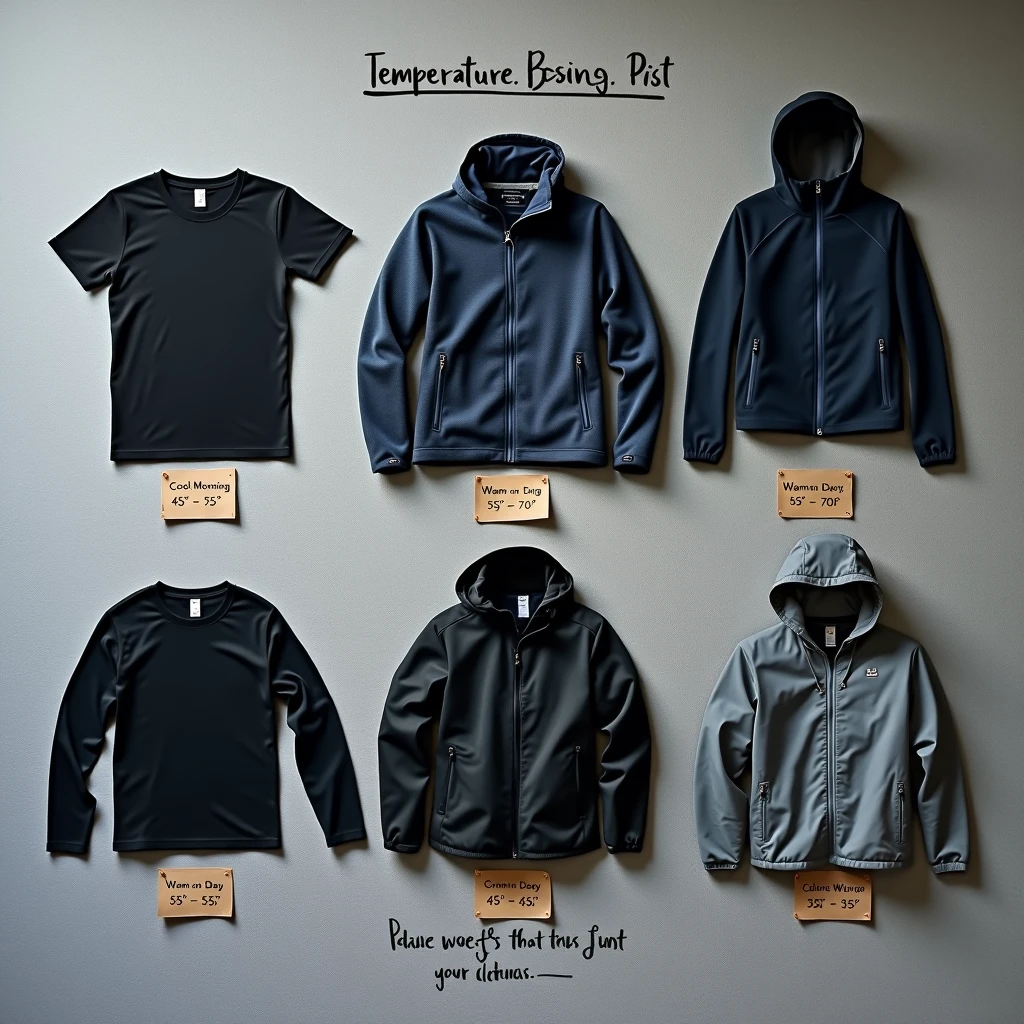
Here's where the three fabrics come together into actual outfits. I've included real products I've used, but the principles work with any brand.
Combo 1: Cool Morning Start (45°F – 55°F)
Merino T-shirt + fleece.
The merino moves sweat. The fleece holds heat. If you warm up on the climb, unzip the fleece or take it off entirely. Tie it around your waist or stuff it in your pack.
Budget example: Decathlon Forclaz Merino T-shirt ($25) + Decathlon MH100 fleece ($15) = $40 total.
Better example: Ridge Merino Wanderer ($55) + Patagonia Micro D ($59) = $114 total.
Combo 2: Warm Day, Steady Movement (55°F – 70°F)
Merino T-shirt only.
Nothing else. You're working hard, the sun is out, you're generating your own heat. This is the simplest layer configuration in hiking, and it works for a huge percentage of the days most people hike.
Budget example:Budget example: Decathlon Forclaz Merino T-shirt ($25).
Better example: Icebreaker Tech Lite II ($80).
Combo 3: Windy or Light Rain (45°F – 55°F)
Merino T-shirt + wind shell.
No fleece. The shell blocks wind. Your body heat does the rest. If the wind dies or the sun comes out, stuff the shell back into its pocket.
Budget example:Budget example: Decathlon Forclaz Merino T-shirt ($25) + Decathlon FH500 windbreaker ($20) = $45 total.
Better example: Ridge Merino Wanderer ($55) + Patagonia Houdini ($109) = $164 total.
Combo 4: Cold and Windy (35°F – 45°F)
Merino T-shirt + fleece + wind shell.
All three layers deployed. The merino moves sweat. The fleece holds heat. The shell blocks wind. This is the maximum three-layer system. It handles most three-season conditions down to near-freezing.
Budget example: Budget example: Full Decathlon setup = $60 total.
Better example: Ridge Merino + Patagonia fleece + Patagonia Houdini = $223 total.
Combo 5: Actual Rain
Swap the wind shell for a rain jacket.
A wind shell will wet out in sustained rain. A rain jacket — waterproof membrane, taped seams, adjustable hood — will keep you dry. Add the fleece underneath if it's cold rain. Skip it if it's warm rain.
Budget example: Decathlon Forclaz Merino + Decathlon MH100 fleece + Frogg Toggs Xtreme Lite rain jacket 99 total.
Better example: Ridge Merino + Patagonia Micro D + Patagonia Torrentshell 3L =293 total.
The "Rules" You Can Ignore
A lot of hiking advice is just someone's preference repeated until it sounds like a rule. You can ignore all of the following without consequence.
"You need a specific base layer designed for hiking."
You need a shirt that doesn't hold water. An old polyester running shirt works. A merino T-shirt works. A cheap synthetic tee from Target works. It doesn't need a "tech" label.
"You have to spend money on a Gore-Tex shell."
Gore-Tex is waterproof. So is Frogg Toggs. So is a $20 PU rain jacket from a department store. Gore-Tex is more breathable and more durable. It's also $200 more. When you're starting out, waterproof matters more than breathable-waterproof. Upgrade later if you want.
"Cotton kills."
Cotton is a bad choice for cold, wet conditions because it holds moisture and loses insulation when wet — which can lead to hypothermia in serious situations. But "cotton kills" is a slogan, not a universal law. On a warm day hike with no rain in the forecast and a car waiting at the trailhead, a cotton T-shirt is fine. Just don't wear it in the snow.
"You need to spend a lot to stay warm."
You don't. The $60 Decathlon setup is warmer than what most people were hiking in 30 years ago. The $223 setup will last longer and feel nicer. Both work.
How to Start Without Overthinking It
Look in your closet. You probably already own:
A polyester T-shirt or workout top (base layer)
A fleece jacket or a wool sweater (midlayer)
Some kind of windbreaker or light jacket (shell)
Go hiking in those. Notice what works and what doesn't. Did your base layer get soggy? Buy a merino one next time. Did your fleece let too much wind through? Add a wind shell. Did you overheat constantly? Start with fewer layers next time.
You don't need to buy a full kit before your first hike. You need to hike first, then build your kit around what you learn. That's not a compromise. That's the actual process.
The Bottom Line
Layering is not a system you buy. It's an instinct you trust, paired with fabrics that don't fail when they get wet.
Your body knows when it's hot and when it's cold. Listen to it. Add a layer. Remove a layer. Use fabrics that dry fast and hold warmth when damp. Everything else — the brands, the technologies, the people on the internet telling you you're doing it wrong — is noise.
Gear up. Get out. (Wear what you have. Upgrade what doesn't work.)
No comments yet — be the first to share a thought.