
I live in Half Moon Bay, where the weather doesn't change day to day so much as hour to hour. The morning starts at 48°F with fog so thick you can't see the ocean from the parking lot. By 10 a.m., the sun has burned through and it's 62°F. By 2 p.m., the wind is back, the fog is rolling in again, and you're cold in a way that has nothing to do with the actual temperature and everything to do with the damp.
I've spent ten years figuring out how to dress for this. Not for the mountains — I know how to dress for the mountains. For the coast. For the in-between. For the days when you're not summiting anything, just living a life that happens to take place outside, in layers, in a place that can't decide what season it is.
Here's the formula.
The Coastal Layering Problem
Mountains have predictable temperature curves. You start cold at the trailhead, warm up on the climb, cool down at the summit, and repeat in reverse. Layering for mountains is about managing exertion — adding and removing layers as your output changes.
The coast is different. The coast doesn't care about your exertion. The coast changes temperature because a fog bank moved in, or a breeze shifted direction, or the sun came out for 22 minutes and then vanished behind a wall of grey. You can be standing still and go from warm to cold in the time it takes for a cloud to pass.
Coastal layering isn't just about managing heat. It's about managing moisture, wind, and the fact that 55°F in Half Moon Bay feels completely different from 55°F in the Sierra. The damp gets into everything. Wind chill comes out of nowhere. The sun, when it appears, is low-angle and intense. You need a system that handles all of this without making you carry a backpack full of clothing changes.
The Formula: 4 Pieces, Infinite Combinations
After years of trial, error, and shivering through too many foggy evenings in a cotton sweatshirt, here's the system:
Layer | Piece | Attributes | Why It Works on the Coast |
|---|---|---|---|
Base | Merino long-sleeve crew | Wicking, odor-resistant, temp-regulating | Handles damp without feeling clammy; breathable enough for sun |
Mid | Lightweight fleece hoody | Breathable warmth, hood for wind | Adds core warmth without bulk; hood replaces beanie |
Outer | Waxed cotton jacket | Wind-resistant, light rain-resistant, breathes | Beats coastal wind better than fleece; reads as "clothing" not "gear" |
Accent | Linen scarf or cotton bandana | Neck warmth, sun protection, packable | The most underrated temperature regulator you already own |
Total weight on body: Not a meaningful number — you're not backpacking. You're living.
The Waxed Cotton Jacket: Why This Piece Matters
Let me defend the waxed cotton jacket before anyone emails me about technical fabrics.
Waxed cotton is not Gore-Tex. It's not breathable in the way a membrane is, and it won't keep you dry in sustained rain. But for coastal conditions — fog, mist, light drizzle, and that particular Pacific breeze that cuts through fleece like it's not there — waxed cotton is nearly perfect.
The waxed finish blocks wind. The cotton body breathes well enough that you don't overheat when the sun comes out. The fabric has weight to it — not heavy, but substantial — and that weight means it hangs cleanly and doesn't flap in the wind. It develops character over time: creases at the elbows, a slight patina where the wax wears thin, a lived-in look that gets better with age.
Most importantly for Trail Style: a waxed cotton jacket doesn't look technical. It looks like a jacket. You can wear it over a fleece on a foggy morning, over just the merino base layer when the sun breaks through, or over nothing at all with the sleeves pushed up when it's warm enough to pretend you're not wearing layers. It crosses contexts in a way a hardshell never will.
My current jacket is a Barbour Beadnell ($299), which I bought secondhand for $120 on eBay. Before that, I wore a Flint and Tinder waxed trucker jacket ($298) for three years until the sleeves frayed. Both did the same thing: blocked coastal wind, handled mist and fog, looked like they belonged at a farmers' market.
Budget alternative: The Legendary Whitetails Tough as Buck jacket ($60–80) or a vintage Lee Storm Rider denim jacket — not waxed, but heavy enough cotton to block moderate wind. Add your own wax treatment for $15 if you want water resistance.
How the System Adapts
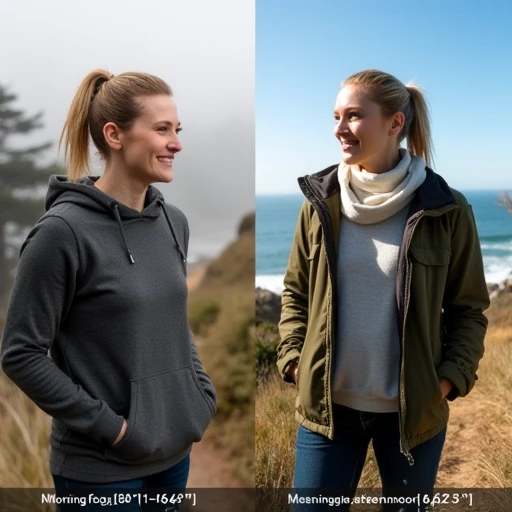
Morning Fog (48°F–52°F, damp, zero visibility)
Wear everything.
Merino long-sleeve as the foundation. Fleece hoody over it, hood up or down depending on how wet the fog is. Waxed cotton jacket over that, collar popped against the damp. Scarf or bandana around the neck — this is the detail that transforms "I'm cold" into "I'm comfortable."
The fleece hood under the waxed jacket collar creates a seal around the neck that blocks wind better than either piece alone. The scarf fills any remaining gaps. Your core stays warm, your neck stays covered, and the merino base layer keeps moisture moving away from your skin.
Key move: Tuck the merino hem into your waistband. It prevents the damp breeze from sneaking up your back when you bend over to leash the dog or load the surfboard.
Mid-Morning Transition (53°F–58°F, fog thinning, sun appearing in patches)
Lose the scarf first.
This is deliberate. The scarf is the lightest, most packable piece. It comes off and stuffs into a pocket or a bag in three seconds. You've now opened a vent at the neckline, which is the most effective single place to regulate temperature. More heat escapes through an unzipped collar than through an unzipped front.
If the sun stays out for more than ten minutes, unzip the waxed jacket but keep it on. The cotton body will hold just enough residual heat while the open front dumps excess.
Key move: Don't take the jacket off yet. Coastal sun is a trick. It'll be gone in six minutes and you'll want the jacket back.
Sunny Afternoon (59°F–65°F, clear skies, light breeze)
Jacket off, fleece on or off depending on wind.
This is where the system earns its keep. Strip the waxed jacket and tie it around your waist by the sleeves, or leave it in the car. You're now in merino base layer + fleece hoody, or just the merino if it's warm enough.
The fleece hoody (mine is an Arc'teryx Kyanite LT, but any lightweight fleece works) is the unsung hero here. With the jacket gone, it becomes your outer layer. The hood provides neck coverage without a scarf. The fabric breathes well enough that you won't overheat at 62°F in the sun, but holds enough warmth that you won't shiver when a cloud passes.
When to drop to just the merino base layer: Direct sun, no wind, above 60°F, and you're moving — walking the dog, strolling the farmers' market, carrying groceries. The merino crewneck reads as a normal long-sleeve shirt. No one will know it's performance wool unless you tell them.
Key move: Push the fleece sleeves up to your elbows. It's the analog version of a thermostat — exposing your forearms dumps heat fast without requiring you to take anything off.
Evening Fog Return (50°F–55°F, fog rolling back in, wind picking up)
Reverse the morning sequence.
Scarf on first. Jacket on second. Zip up. Collar up. Hood up if the damp is heavy. The system rebuilds itself in the same order it came apart, and you're back to full coverage in 90 seconds.
Key move: If you're transitioning from a sunny activity (outdoor dinner, beach fire, walking back to the car) and you've been warm, put the jacket on before you feel cold. Coastal cold comes on fast, and once you're chilled, it takes twice as long to warm up. Proactive layering. Don't wait until you're shivering.
Why Cotton Gets a Pass Here
In my mountain layering guides, I tell you never to wear cotton. Cotton kills. Cotton holds moisture, loses all insulating ability when wet, and turns a cold situation into a dangerous one.
The coast is different. You're rarely hours from shelter. You're not above treeline in a storm. The consequences of getting damp are discomfort, not hypothermia. And waxed cotton, specifically, is treated to resist moisture penetration — it's not raw cotton. The wax fills the fibers and creates a barrier that light rain and fog can't penetrate quickly.
This distinction matters because it opens up style options that mountain gear doesn't allow. A waxed cotton jacket looks good. It ages beautifully. It doesn't crinkle. It doesn't shine. It transitions from a foggy beach walk to a coastal café without a costume change. You can't say that about a Gore-Tex shell.
The Brands I Actually Wear (And Why)
Merino Base Layer: Icebreaker 200 Oasis Long-Sleeve Crew ($100)
200gsm merino, flatlock seams, offset shoulder seams. I've worn this exact base layer for three winters and the only sign of age is slight pilling at the lower back from pack friction. Important detail: the women's cut has a shaped hem that's longer in the back, which means it stays tucked in when you bend over. Not all merino base layers do this.
Budget alternative: Ridge Merino Journey Long-Sleeve ($65). 190gsm, slightly heavier, slightly cheaper, equally durable. The fit runs larger than Icebreaker, so size down if you're between sizes.
Lightweight Fleece: Arc'teryx Kyanite LT Hoody ($169)
This is a technical fleece that doesn't look technical. The face fabric is smooth and matte — no grid pattern, no shiny finish, no elastic binding at the hem. It reads as a cotton-blend hoodie from six feet away. But it's Polartec Power Stretch Pro, which means it breathes like a fleece, stretches like a yoga shirt, and dries faster than cotton. The hood fits close to the head without a drawcord, which keeps the clean look intact.
Budget alternative: Uniqlo Pile-Lined Sweat Full-Zip Hoodie ($39.90). Not technical, not quick-drying, but warm and soft and reads as completely normal clothing. For coastal casual wear, it works. Don't take it on a rainy hike.
Waxed Cotton Jacket: Barbour Beadnell ($299) or Secondhand
The Beadnell is the women's-specific version of Barbour's classic Bedale. It has a tailored waist, a corduroy collar, and that distinctive waxed cotton smell that either you love or you don't. I bought mine on eBay for 120andre−waxed it with a120 and re−waxed it with a 15 tin of Barbour Thornproof dressing. It took an hour and a hairdryer. It's been through three coastal winters and looks better than when I bought it.
Budget alternative: Legendary Whitetails Tough as Buck Jacket ($60-80) — a barn coat style that's surprisingly well-made for the price. The cotton is heavy enough to block wind, and you can wax it yourself for water resistance. Start with a secondhand Barbour if you're patient on eBay.
Scarf/Bandana: Vintage Linen Scarf (eBay, $10–20) or Standard Cotton Bandana ($5)
Linen is the move for coastal scarves. It's breathable enough that you won't overheat when the sun comes out, but dense enough that it blocks wind when wrapped around the neck. Cotton bandanas work too — they're lighter, smaller, and more packable. I keep one in the pocket of my waxed jacket at all times. It costs $5 and adds more temperature flexibility than any other single item.
Key move: Learn the basic neck-wrap fold. Fold the bandana into a triangle, roll it from the wide end to the point, tie it loosely around your neck. It covers exactly the gap between your collar and your chin. Twenty seconds. Works every time.
What This System Doesn't Do
This is not a hiking system. It's not for high exertion. It's not for real rain — if the forecast calls for sustained precipitation, swap the waxed cotton jacket for a rain shell and the fleece for a synthetic insulated layer.
This is a living system. It's for dog walks, farmers' markets, beach bonfires, coastal road trips, outdoor brunches, surf checks, and the kind of day where you're in and out of the car eight times. It's for looking put together while being genuinely comfortable in conditions that change by the hour.
The goal isn't technical performance. The goal is to stop thinking about what you're wearing so you can pay attention to where you are.
The Bottom Line
Coastal weather doesn't follow rules. It follows fog banks and wind shifts and the angle of the sun. The solution isn't to carry a full wardrobe or to wear technical gear designed for summits you're not climbing. It's to build a small system of pieces that work together, come apart in the right order, and look like regular clothes.
Merino base layer + fleece hoody + waxed cotton jacket + scarf or bandana. Four pieces. Infinite combinations. One foggy morning to one sunny afternoon, and back again.
Gear up. Get out. (Even if it's just to the farmers' market.)
No comments yet — be the first to share a thought.