I own eight jackets. Four are technical shells. Two are fleece midlayers. One is a puffy that lives in the trunk of my car. One is a denim jacket I bought at a thrift store in 2018 and have worn maybe six times.
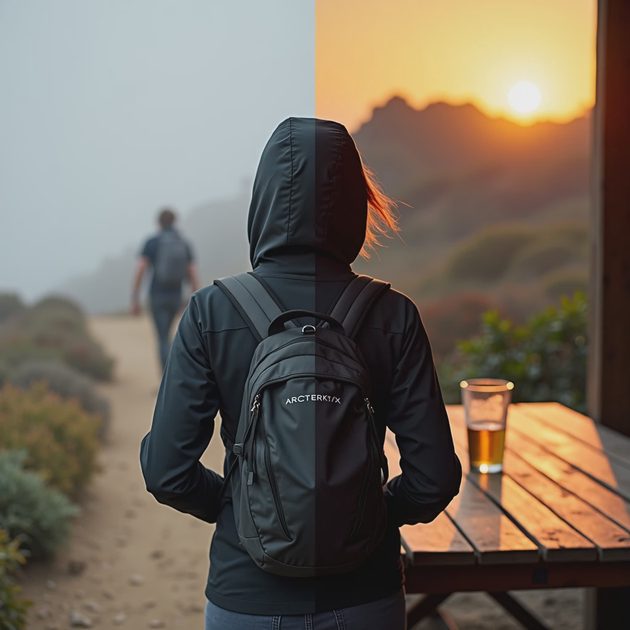
But if I had to pick one — the jacket that goes from a 6 a.m. trailhead to a 7 p.m. brewery patio without a costume change, without looking like I just rappelled off the roof, without making me choose between function and looking like a functional human — it's the Arc'teryx Atom LT Hoody.
Here's why this one jacket has outlasted, outworked, and out-styled everything else in my closet.
The Problem: Most Jackets Only Do One Thing
Technical shells look technical. A hardshell at a restaurant sounds like a potato chip bag every time you move your arm. People turn around at the bar. You know the sound. I know the sound. The bartender definitely knows the sound.
Fleece jackets are cozy but useless in wind. Down puffies are warm but turn into a wet napkin in rain. Denim jackets look great at the brewery and terrible at 8,000 feet when the temperature drops and the wind picks up.
The outdoor industry wants you to buy five jackets for five scenarios. The Atom LT Hoody made me realize I only needed one.
What the Atom LT Actually Is
Let me be clear about what this jacket is — and isn't.
The Atom LT is a synthetic insulated midlayer with a breathable fleece side panel and a DWR-treated outer face. It weighs 11.3 oz. The insulation is Coreloft Compact 60 — Arc'teryx's proprietary synthetic fill that resists moisture, compresses reasonably well, and keeps insulating even when damp. The outer fabric is Tyono 20, a lightweight nylon that blocks light wind and sheds light rain. The side panels and underarms are Polartec Power Stretch fleece — the secret ingredient that makes this jacket breathe during activity instead of turning into a personal sauna.
It's not a rain jacket. It's not a belay parka. It's not a fashion piece designed by someone who's never seen a mountain. It's the gap-filler. And as it turns out, the gap is where most of life happens.
Summit: Why It Works on the Trail
I've worn the Atom LT on at least 60 hikes in the past three years. Here's where it excels and where it doesn't.
What it handles well:
Cold starts. A 38°F trailhead at 6 a.m. is the Atom's natural habitat. Over a merino base layer, it holds enough warmth for the first mile until your body heat kicks in. By mile two, the fleece side panels are actively venting excess heat. By mile three, I've usually unzipped the front but kept it on — and I'm still comfortable.
Windy ridgelines. The Tyono face fabric blocks wind significantly better than a fleece or a softshell. I've worn it on the exposed section of the Skyline-to-the-Sea trail with 25-mph gusts and felt the wind push against the jacket without cutting through. The hood fits over a beanie and stays put in wind, which is more than I can say for most non-helmet-compatible hoods.
Stop-and-go pace. This is where the Atom LT beats every other jacket I own. On a hike with uneven effort — steep climbs followed by flat sections, photo stops, snack breaks — a fleece is too cold when stopped, and a puffy is too hot when moving. The Atom LT sits in the middle: warm enough when you're still, breathable enough when you're moving. The fleece side panels dump heat. The insulated core holds it. It's a smart piece of thermal engineering.
What it doesn't handle:
Sustained rain. Light drizzle and mist, yes. The DWR beads water for about 30 minutes. Then it wets out. The Coreloft insulation still works when damp — unlike down — but you'll be cold and damp if you're in real rain without a shell over it. This is not a rain jacket. Bring a shell if rain is in the forecast.
Intense aerobic output. Running uphill in 50°F weather, the Atom LT is too warm — even with the side panels venting. For high-output activities like trail running or fastpacking, you want a breathable fleece or a softshell. The Atom LT is for hiking, walking, and moderate-output days, not for redlining.
Sunset: Why It Works Everywhere Else
Here's the part that matters for Trail Style. The Atom LT doesn't look like outdoor gear in the places where outdoor gear looks out of place.
I've worn it to:
A brewery in Half Moon Bay after a 10-mile day hike (didn't change)
A casual dinner in San Francisco (paired with black jeans and clean sneakers)
A work meeting on Zoom (hood down, no one knew it was a technical jacket)
Three flights as a travel layer (packs into its own sleeve, doubles as a pillow)
Multiple grocery runs, coffee runs, and "I don't know what the weather is doing" days
The fit is trim but not tight. The face fabric has a matte finish — no shiny nylon sheen, no crinkly hardshell noise. The hood doesn't have a stiff brim that screams "I'm prepared for a blizzard." The overall silhouette reads more "put-together casual" than "technical outerwear."
The key design details that make this crossover work:
The matte fabric. Shiny jackets read as rain gear. Matte jackets read as clothing. The Tyono face has a soft, almost cotton-like hand feel that doesn't reflect light. It's the single biggest reason the Atom LT works in non-technical settings.
The clean lines. No excessive pockets, no Velcro patches, no dangling cords. Two zippered hand pockets, one internal chest pocket, a clean front zip. That's it. The design is minimalist in a way that doesn't call attention to itself.
The stand collar. When the hood is down, the collar stands up neatly around the neck instead of flopping open like a deflated balloon. Small detail, huge difference in how put-together it looks.
The colorways. Arc'teryx offers the Atom LT in both loud alpine colors and muted everyday tones. Mine is in "Orca" — black body, black fleece panels, subtle tonal logo. It reads as "nice jacket" not "I summited something earlier."
The 24-Hour Test
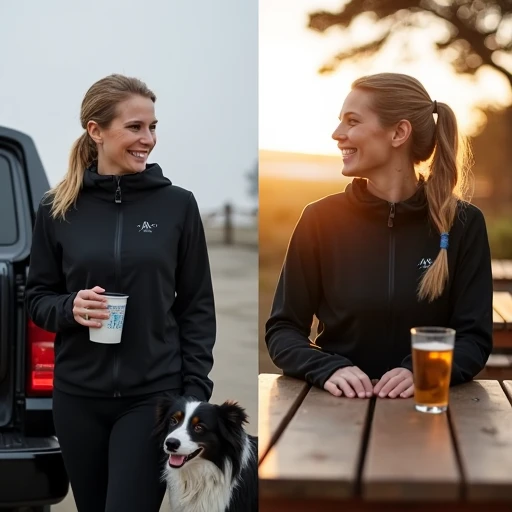
Last spring, I did a deliberate test: wear the Atom LT for a full Saturday, from trailhead to dinner, documenting exactly what I did and whether the jacket held up. Here's the log:
6:15 a.m. — Pillar Point parking lot. 47°F, foggy, light breeze. Wearing Atom LT over a merino T-shirt. Comfortable immediately. No shivering while drinking coffee on the tailgate.
7:30 a.m. — Hiking Skyline-to-the-Sea. 49°F, still foggy. Moving well, starting to warm up. Unzipped the jacket but kept it on. Fleece panels venting. No sweat buildup.
10:00 a.m. — Ridgeline section. 54°F, fog burning off, 15-mph wind. Zipped up. Wind blocked. Hood up for five minutes during a gust, then down.
12:30 p.m. — Lunch at a viewpoint. 58°F, sun out, slight breeze. Jacket off while sitting in the sun. Put it back on when clouds moved in. Packed down into its own sleeve and used briefly as a lumbar pillow.
3:00 p.m. — Back at the car. 61°F. Jacket off for the drive.
5:30 p.m. — Brewery in Half Moon Bay. 56°F, outdoor seating, coastal breeze. Jacket back on over the same merino tee. Not overdressed. Not underdressed. Just right.
8:00 p.m. — Walking the dog. 50°F, fog rolling back in. Hood up, hands in pockets, warm.
Verdict: The jacket handled a 15-degree temperature swing, light wind, brief fog mist, a sweaty climb, and a social setting without a single moment of "I wish I'd brought a different jacket."
What It Replaces in Your Closet
If you buy an Atom LT, here's what you can stop wearing — or stop buying:
It replaces:
A light fleece (the side panels handle breathability)
A light puffy (the Coreloft handles insulation)
A casual windbreaker (the Tyono face blocks moderate wind)
A "nice hoodie" for everyday wear
It doesn't replace:
A rain shell (not waterproof)
A heavy winter parka (not warm enough below 25°F when stationary)
A high-output running layer (too warm for running)
Four jackets replaced by one. That's closet space, money saved, and decision fatigue eliminated.
The Durability Question
I've worn my Atom LT for three years, roughly 200 days of use. Here's the damage report:
Face fabric: No tears, no snags. The matte finish has developed a slight patina at the cuffs and collar where oils from skin contact have darkened the fabric slightly. It looks lived-in, not worn-out.
Fleece side panels: The Polartec has pilled lightly at friction points where my backpack straps sit. A fabric shaver cleaned it up in five minutes. No thinning, no holes.
Insulation: The Coreloft has lost maybe 10-15% of its loft compared to new — normal for synthetic insulation after 200 days. It's slightly less warm than it was on day one, but still warmer than any fleece.
Zippers: All three zips still glide smoothly. No catching, no splitting.
DWR: I've reapplied DWR spray twice in three years. The factory treatment lasted about six months of regular wear. Reapplication is easy and restores beading.
For a jacket that costs $280, three years of daily-usability with no functional failures is a reasonable return. Expect 4-5 years of hard use before the insulation degrades noticeably.
Are There Alternatives?
Yes. But none that hit the same crossover sweet spot.
Patagonia Nano-Air Hoody ($299): Softer, stretchier, more breathable than the Atom LT. Better for high-output activity. But the face fabric looks more technical, the sheen is more visible, and it doesn't read as "casual" in non-outdoor settings. If you're a climber or a fastpacker who prioritizes breathability over versatility, the Nano-Air might be better. For the rest of us, the Atom LT passes in more places.
REI Co-op 650 Down Hoodie ($129): Half the price, just as warm, and packs smaller. But down fails when wet, and the REI jacket looks unmistakably like a puffy. It's a great budget warmth layer. It's not a summit-to-sunset jacket.
Patagonia Better Sweater Fleece ($139): I wrote about this one in my fleece comparison. It's excellent for everyday wear and light hiking. But it's not wind-resistant, not packable, and not warm enough when temperatures drop into the 30s. The Atom LT covers a wider range.
The Bottom Line
The Arc'teryx Atom LT Hoody is the one jacket I'd keep if I had to give away the other seven. It's not the best at any single thing — there are warmer jackets, more breathable jackets, more waterproof jackets, more packable jackets. But no single jacket I've worn balances warmth, breathability, wind resistance, weight, durability, and everyday style as well as this one.
If you're building your outdoor wardrobe and trying to decide where to put your money: buy a merino base layer, buy a good rain shell, and put the rest into an Atom LT. It'll be the piece you reach for most often — not because it's the most technical, but because it's the most useful.
Summit at 10 a.m. Sunset at 7 p.m. Same jacket. No costume change.
Gear up. Get out.


No comments yet — be the first to share a thought.